Sunday, April 18, 2010

A Revolution in Fence Design


Something I do read when I read my books is to turn the page corners over on pages where I find interesting passages or thoughts. Then, when I reread the book, it amuses me to try and re-find what had previously resonated with me. The other day I was once again reading Robert Pirsig's Zen and the Art of Motorcycle Maintenance when I came across not only a bent corner, but an underlined sentence, “ When you live in the shadow of insanity, the appearance of another mind that thinks and talks as yours does is something close to a blessed event. Like Robinson Crusoe's discovery of footprints on the sand." I can't say if this is true or not. I was likely just being hopeful. In reflection though, I think I felt a bit like this when I first found the permaculture design manual while browsing the stacks at the London Public Library. Before you start lowering my coolness factor by a few notches, I'll have you know that I am permanently banned from this library, as I believe is my brother. In any case, the information and philosophy of the book seemed to make so much sense to me; it was like I found something that I didn't even know I was looking for. So they live happily ever after right? Not really. I think that being a permaculturalist in our type of society and civilization can make you feel isolated from the masses. It is probably the same in any type of movement that wants to totally reconstruct society along different principles than it is currently following. And the further down the path you go, the more estranged you will feel. Of course you are regarded as the crazy one for wanting to design something along sustainable ecological principles instead of living as if we have unlimited renewable earths (which is totally insane). Ah, to be able to take the blue pill of the Matrix… T’would be so much easier. Once you know though…

Alrighty, this blog was supposed to be about building a fence. Hopefully it will tie back together with my rambling introduction in the end, if not oh well. In permaculture, a fence is not, CANNOT simply be a fence, as that would mean no stacking of functions. Let’s backtrack a bit so I can explain a bit more about what I mean and give you a glimpse of the permaculture design process. First the problem: the western edge of our property faces a road and offers a perfect view of our yard to anyone passing by and to our neighbors across the street. Don't get me wrong I like my neighbors, but I also like to do tai chi and yoga in the backyard and it can be a bit unnerving when there is an audience. So the main function of the fence, as defined by the problem, would be to block the view to give us some privacy. I could of course buy some lumber to make it but then that brings in the problems of cost, chemicals in pressure-treated lumber, and the destruction of forests, etc. Luckily, because of my policy to try to not export nutrients and material from the property, I still had a huge pile of branches from two trees that took down this winter to make room for some full sun garden beds, as well as some fruit trees (you have to break some eggs to make an omelet). Free indigenously grown building materials! Furthermore, instead of a single function fence, why not use the branches to make a trellis for the vertical gardening of beans, peas, cucumbers, tomatoes, morning glories, et cetera. As a bonus, the wall would be situated behind the kids’ “restaurant” that is located under a weeping mulberry, which I have previously written about. It will further define their restaurant area and give them something to munch on as well. Nothing like a living living space for the kids to play in. So, instead of a consumptive single observation barrier, we would have a multi-purpose observation barrier/trellis/wall/food system. That is what I mean by a stacking of functions.
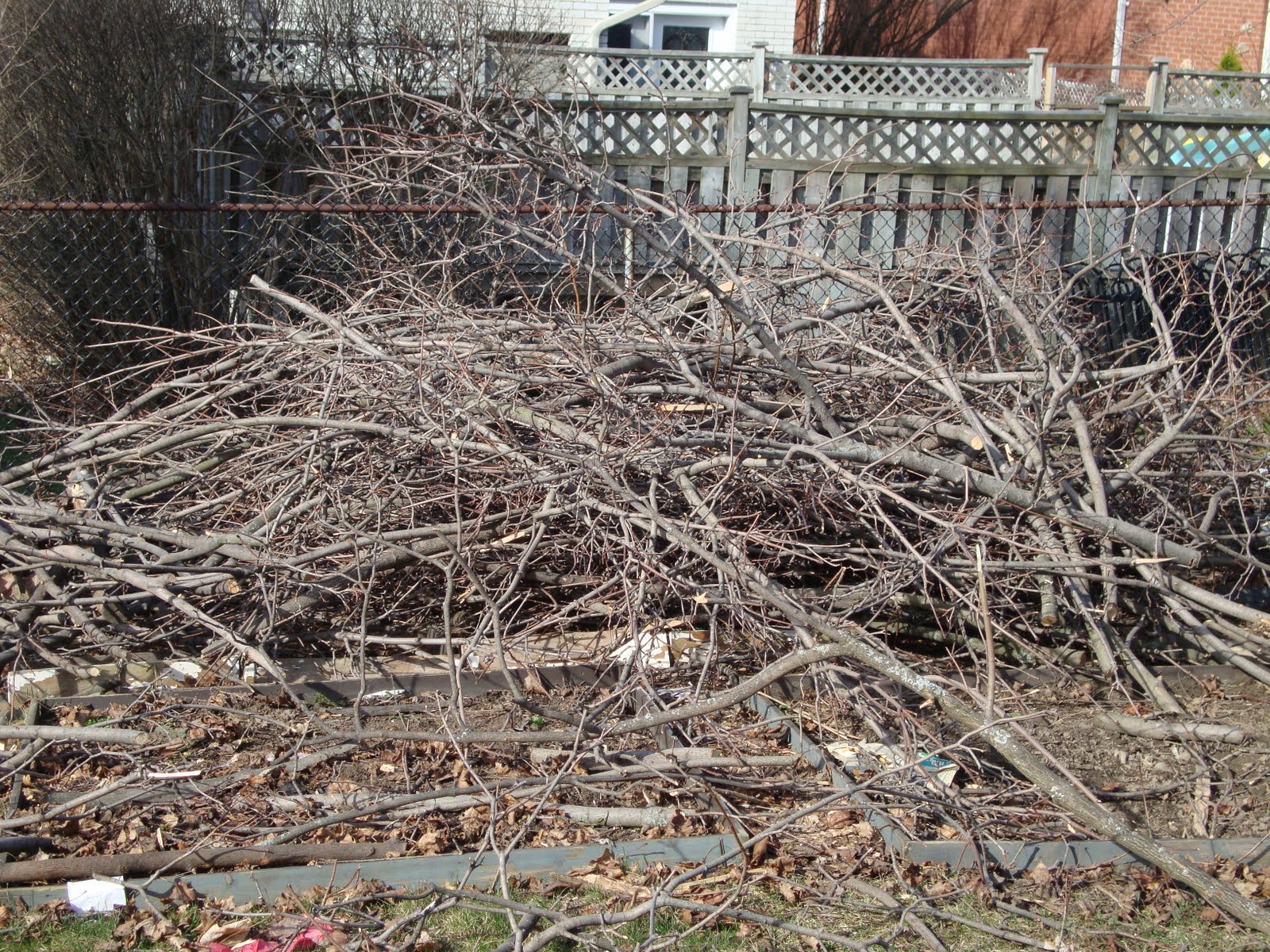
Many hands make light work so I asked my son if he wanted to build a garden fence with me. He said, “I'll help you with anything you want in the garden Daddy.” Music to my ears. He asked what we were going to make the fence out of and I pointed at the massive, inter-tangled branch pile and said, “Some assembly required,” which he found pretty funny. There was nothing really difficult about making it. We dug holes and placed upright delimbed branches them with a bit of cement to make them more stable and then affixed horizontal branches using rope and square lashing. I found the instructions for the lashing I on the internet. The bed around the trellis still has to be dug and/or mulched, but that can wait until next weekend.


Most of the reactions the fence have been positive. My kids like it, my wife likes it, even my sister-in-law likes it. I even had a couple stop along the street while I was making it to tell me that they liked it and that I should check out their parent’s garden. However, a friend of mine commented on a picture of the fence I posted elsewhere, “Is that to keep the neighbours’ kids out of your pumpkin patch??....I’m scared just looking at pics of it....oopppsssss.....sorry Deb...I wasn't supposed to say anything about Paul's garden....” (Deb is my wife and he was referring to how she often doesn’t like my ideas I imagine). Of course he was just teasing; we are always ribbing each other. I do think though that even though he was joking, it does highlight some of the underlying views that people have about my style of gardening and ecological landscaping design, i.e., it is off-the-wall, so to speak. Thus the tie in to the beginning of this blog, something that can make me feel more at one and inline with nature can at the same time make me feel estranged from society. As for being scared, I agree with them. The fence/observation barrier/trellis/living wall/vertical garden is only the TIP of the iceberg of what I have planned. And the plan calls for a COMPLETE restructuring of civilization, if it is enough to only restructure it, and that IS scary. One way to pull it all down is to start growin’ your own. Why would growing your own food be a threat to society? Because it is free, for, as Daniel Quinn says, our civilization cannot have free food, if it were free, who would want to work?

Tuesday, March 2, 2010

Paul Jasinski’s Foundation Books

The other day in an earth science class that I was teaching I mentioned that there are a number of books that I regard as my “foundation books”. These are the books that have shaped (or confirmed?) the way that I look at the world, how I interpret it, and how I respond to it. Some people in the class wanted me to post a list of the books. For better of for worse here they are:

Ishmael – An Adventure of the Mind and Spirit, Daniel Quinn
The Story of B, Daniel Quinn

What makes Quinn’s books interesting is his ability to step back and see things that we are so immersed in that they seem to be the natural order of things. He is like an alien anthropologist examining the earth and its inhabitants. These books deal with how and why our culture is destroying the world. Ishmael has a really interesting take on the Garden of Eden creation myth and how it ties into what we call the agricultural revolution, one that really makes sense. Another important point is that it is not humanity that is flawed, but our civilization. There is a difference between the two.

It think Daniel Quinn’s other books are better written that Ishmael but I would still start with it, as it is a quick read with some really deep concepts. The Story of B expands on these concepts in a much better literary fashion. All of Quinn’s books have something to offer.

Guns, Germs, and Steel, Jared Diamond
I like this book because it is kind of scientific parallel to Ishmael and deals with how civilization has developed over the last 13 000 years. He discusses the preconditions that were necessary for the agricultural revolution and why it didn’t happen in other areas of the world.

Collapse – How Societies Choose to Fail or Succeed, Jared Diamond
I think it is kind of funny (well not really funny) how our society seems to have an “it could never happen to me” attitude to disasters and cultural collapse. There have been many societies that previously flourished and then collapsed due to combinations of climate change, resource overuse, and a lack of societal response to warning signs of an upcoming disaster. This book provides several examples of these collapses. It is a good follow up to Guns, Germs, and Steel, which focused more on the build up of civilizations.

Shovelling Fuel for a Runaway Train: Errant Economists, Shameful Spenders, and a Plan to Stop them All, Brian Czech
A great book looking at economics from an ecologist viewpoint (and there really is no other way if you want to have a planet to live on). This book basically says something simple: you can’t have unlimited growth on finite resources. He argues for a zero growth or steady state economy. Besides linking the economic and ecological systems, he also discusses how changes in societal perceptions and choices could help overthrow our current system. What would happen if rich people, instead of being looked upon as powerful and successful, were regarded as wasteful and as resource/Earth destroyers? What if this was part of the “mating game”, where people did not want partners that were rich because they had an understanding of what this actually meant to the Earth and the rest of society? Well, for one, I would likely be a hell of a lot more popular.

Permaculture – A Designers Manual, Bill Mollison
Switching to the applied and practical, permaculture is a design system for constructing sustainable (i.e., can survive (and thrive) through time) human settlements and agricultural systems that use principles derived from observing natural systems. This is the classic permaculture “textbook”. Even after having it for years I am always finding new stuff in it or reinterpreting things that I have already read before. The key point of this book is the word “design”. Let’s design something that works. Right now our systems are not working and they don’t seem to be led by design. Also key in this book is The Prime Directive of Permaculture, which is, “The only ethical decision is to take responsibility for our own existence and that of our children”. What would happen if all of our decisions and designs were shaped by this directive? Get this book and start designing and implementing a positive, sustainable future.

I also suggest reading David Holmgren’s books including Permaculture – Principles and Pathways Beyond Sustainability. Holmgren is the co-founder of permaculture and offers a bit of a different viewpoint. The Earth Care Manual – A Permaculture Handbook for Britain and other Temperate Climates by Patrick Whitefield is another good book. In fact, I think you should read them all.

Gaia’s Garden – A Guide to Home Scale Permaculture, Toby Hemenway
This is the book that I would have liked to written. It is permaculture at the garden scale and shows how to design a garden that mimics natural systems for maximum outputs and minimal inputs. Learn about no-dig gardening, polycultures, garden layers, importance of biodiversity, edible weeds, garden guilds… A must have for any gardener.

The One-Straw Revolution: An Introduction to Natural Farming, Masanobu Fukuoka
This book outline’s one mans journey from scientist to a sort of farmer/monk. He developed a system to grow rice and grains with no pesticides or fertilizers. While his methods would have to be adapted to other crops and regions, the point is that food can be grown in a sustainable, non-destructive manner. To me his philosophical outlooks are just as important as his farming techniques:

“If we do have a food crisis it will not be caused by the insufficiency of nature’s productive power, but by the extravagance of human desire”.

“And the scientists, no matter how much they investigate nature, no matter how far they research, they only come to realize in the end how perfect and mysterious nature really is”.

So these books (along with perhaps The God Delusion and Zorba the Greek) pretty much sum up my viewpoints and perspective of the world. It should now be pretty easy to figure out my motives for wanting to transform my yard into an urban garden and why I don’t really care what the neighbours may think (in fact, I would argue that those who are not urban gardeners are either not thinking or are simply uniformed). As always, I am interested in hearing your thoughts and views on these books or the subjects contained within.

Sunday, August 23, 2009

Permaculture Persecution

I am sure that a lot of my permaculture buddies can sympathize with me about the experience of discussing an exciting permaculture design or idea with someone and then having them respond with “no”, “it will be messy”, “what will the neighbours think”, etc. For those of us who put their heart and soul into permaculture, these responses can be very disheartening. I think that often times these negative responses have to do not only with misconceptions regarding permaculture, but also with different perceptions regarding beauty. In fact, I would bet that most people have not really thought about beauty and depth and that their perceptions regarding beauty are only skin deep.

Here is a case study that concerns “what the neighbours think”. A couple of weekends ago I got into a lively debate at a party with a neighbuor who doesn't like the idea of me (eventually) cutting down the Norway Maple on our front lawn to make way for fruit trees. Her main objection was that she liked the way the tree looked when she walks by. Someone else got into the conversation and asked why I wanted to cut the tree down. When I told her that it was to plant fruit trees in its place she replied, “wouldn't that be, uhhhh…., ugly?” I can assure you gentle reader that I did not say the first thing that came to mind. All I could think of saying at the time was that I guess people have different perceptions of beauty.

Why do I perceive planting fruit trees on my front lawn as beautiful?

There is beauty in the actual fruit trees themselves. While a large maple can be beautiful as well, I would say that a flowering cherry tree, along with the subsequent cherry tree covered in red fruit, is more aesthetically pleasing than a Norway Maple, at least on my front lawn.

There is beauty in eating fruit from your own yard knowing that it hasn't been sprayed with chemical pesticides or fertilized with inorganic fertilizers.

There is beauty in knowing that the fruit from your yard only traveled 20 m on foot to the kitchen rather than being transported from Chile, California, or even St. Jacobs, for that matter, using fossil fuels.

There is beauty in seeing your children get excited about eating fruit grown in their own yard. Take a look at the picture at the end of the blog of my kids eating cherries grown on a dwarf tree in a half barrel.

There is beauty in seeing the kids calling a fruit tree on the property “the restaurant” because of its prolific berries. In this case it is a weeping mulberry. One of our neighbour’s kids even made two pies with berries picked from the tree and gave one to us.

There is beauty in knowing that your fruit trees will help support the local bee populations that are currently under threat from a variety of sources.

There is beauty in knowing that the fruit trees on your property are producing food for your family and not just shade and leaves to rake.

Taking into consideration these aspects, I think that a much deeper appreciation of beauty can be found than simply the appearance of one tree or another. If and when a similar discussion comes up, I hope I will be better prepared to articulate my thoughts and feelings on permaculture and the beauty of home grown food. Please feel free to share any experiences or thoughts that you have had pertaining to permaculture persecution or differing appreciations of beauty.


Here are my kids picking the first ripe cherries from a dwarf tree grown in a half-barrel on the driveway.

Remember, FOOD NOT LAWNS!

Sunday, February 8, 2009

What Goes Around Should Come Around: Nutrient Cycling Part 1

Permaculture is a design system that is largely based on modeling natural systems, forests in particular (other ecosystems should also be modelled!). To successfully model something, a key component is first carefully observing it. Thus, one of the key principles of permaculture is listed as:

Observation: protracted and thoughtful observation rather than protracted and thoughtless labour.

If we observe a forest, we see that every autumn leaves of the trees fall to the forest floor where they are then broken down by bacteria, fungi, bugs, and worms (though the worms are a relatively new addition in North America and are changing some of the ecological dynamics of the deciduous forests). The breakdown of the leaves, and in fact anything else that the dies in the forest, results in the nutrients being released so that they can be taken up and incorporated in the growth of other plants and animals. The nutrients are cycled. Nothing is being wasted, it is all being reused and transformed - coming from the earth and returning to the earth. This fact is reflected in many of the creation myths that exist around the world. Many of them involve the first peoples being created from earth or mud. In one of the two biblical creation myths, there is a character named “Adam”, which apparently means “red earth”.

Another example is that we bury our dead in the earth. I haven’t looked into the origins of this, but it could reflect this knowledge of things coming and returning to the earth. Early peoples would have known that there is a transformation from life to death and from death to life (city dwellers have for the most part lost this connection, as they tend to not kill their own food, but instead opt to buy it at the supermarket). I have seen old Inuit camps in the tundra of the Northwest Territories where patches of wildflowers grow on small “refuse mounds” that contained the butchered remains of caribou or muskox. The nutrients contained in the bones, blood, and other animal parts support a diversity of life that is absent from the adjacent nutrient poor soils, even though hundreds of years may have passed since the mounds were made. The nutrients keep cycling and cycling and cycling. Native Americans were also said to bury fish with the corn crops to fertilize them and provide better growth. Similarly, gardeners today often amend their soils with bone and blood meal.

When our beloved cat Dr. Livingstone died, I buried him on the Hill behind her house that he used to frequent and planted some native prairie flowers on his grave. My kids know that this not only marks where he is buried, but also that he is being transformed into flowers. If this sounds bizarre, it is only because we have forgotten that this is how nature works and we, and everything else around us, are part of nature and its processes. Life to death, death to life.
Getting back to a wonderful process of nutrient cycling, I like to think of how the landscape developed in southern Ontario over the last 12,000 years or so since the glaciers melted. After perhaps a brief tundra/shrub tundra phase, spruce invaded the landscape creating the first forests. The spruce were then largely replaced by pines, which, in turn, were replaced by the deciduous species that we now have in the forests (varying in temporal and spatial abundance and composition, of course. I have the HARDEST time putting down statements without qualifying them… Nothing in nature is ever really so straightforward). During the majority of this 12000 year period, whatever died and fell to the ground was pretty much cycled back into the immediate system. There was no waste. Contrast that with our typical urban environments. In Kitchener, we have abundant lawns where the grass “wastes” are bagged and then picked up by the city every two weeks. The export of nutrients from the lawns typically necessitates the use of fertiliser to replace them. On of the typical trees planted in the city is Norway Maple. This, non-native tree, which seems to be particularly affected by fungal “tar spots” (unlike native maples), produces abundant leaves that make gardening around them difficult due to the shade. Again, in the fall these leaves (along with most other tree leaves in the city) are raked and bagged with all the carbon and nutrients being exported from the site. These “wastes” can and should be reincorporated into the site! What we are doing goes directly against what we observe in natural systems. Note that while I collect peoples bagged leaves for my garden, I don’t collect grass clippings as they often contain herbicides and pesticides. I have had a “hot” compost pile go cold as they beneficial bacteria within were killed by the addition of poisons in contaminated grass clippings that I added.

Another example, Kitchener has started a “green bin” program. It is an expensive program that is “designed” to save space in our land fills by picking up decomposable kitchen wastes and shipping them to another city for composting. So of course it involves buying plastic bins for everyone, as well as buying new trucks (or retrofitting old ones I don’t really know) with dual garbage/organic waste compaction systems. They evaluate the success of the program with the percentage of households participating. The higher the percentage, the more successful the program. However, in my humble view, the higher the percentage, the less successful the program is because people are NOT keeping the “wastes”, which are actually resources, onsite! Think of a nice environmentally conscious neighbourhood where most of the households compost their green and yard wastes. The city would designate the green bin program in this neighbourhood a “failure” due to their low participation! Now, the city does still promote composting, but I still think that adding the green bin program just adds on to a problem instead of fixing it.

Fixing the problem… A good design goes to the root of the problem and doesn’t just address the symptoms. Look at all of the costs associated with “fixing” the kitchen/lawn waste “problem”. Trucks costs and energy and pollution associated with their construction, operation, and maintenance, shipping the wastes to another city, labour, gas, exportation of nutrients, importation of fertilisers… My next entry will look at ways in which this problem can be fixed by modelling natural systems and the benefits of doing so. If have any other “cons” associated with the exporting of our yard/kitchen wastes, please add them in the comments section.

Thursday, January 22, 2009

Backcast and Take Charge of Your Future!!!

One of the few memorable concepts in that I remember from my undergraduate years is that of forecasting and backcasting and their use in the planning process. Forecasting seems to be the technique used by most governments, utility companies, and municipal planning departments. In order to forecast, one extends a current trend and then plans your actions to meet this extrapolation. For example (and I do realize that this is a gross simplification), if Ontario is using X amount of electricity with the current population, then if the population doubles we would then used twice the electricity. What action would we take to meet this demand? Easy, build twice as many nuclear power plants.

In contrast, to backcast one envisions a desired scenario or outcome and then plans successive steps and actions to reach this goal. So in the case of Ontario doubling its population, an alternative envisioned future might be a more energy-efficient society that uses electricity from multiple green or at least greener sources, which may include small scale hydro plants, and solar and wind generated electricity. Energy use could become more efficient through simple steps such as phasing out incandescent light bulbs and using compact fluorescent or LED lights and legislating the use of energy-efficient appliances. Of course lots more could and would have to be done. These are just off the top of my head and I'm hoping that they will at least illustrate the difference between forecasting, which I view as reactive, with backcasting, which I regard as proactive. To me a proactive approach is much better, as it allows us to guide our society and civilization towards something that we would like it to be rather then simply heading in the direction of its own unplanned inertia.

On this much smaller scale, I can use backcasting for my own permaculture design approach by envisioning not only with what kind of landscape I would like to have, but also what kind of activities would I like to be doing on it. I think that second question is important, as too often conventional design is based on “looking nice” rather than what it will actually be used for or on what actually makes you feel good.

Bread oven built with on-site clay: I see not only great bread, but great outdoor pizza parties and social events.
Flower cutting garden: a fresh cut flowers for the table, food and habitat for beneficial insects.
Backyard play area: a play area of lawn behind the house where I can do tai chi, run around with the kids, etc.
Berry patches: multiple berry patches using different varieties of strawberries, raspberries, blueberries, and currents, to provide berries from spring to fall.
Medicinal garden: various medicinal plants such as chamomile, Echinacea, feverfew, etc. There is something both romantic and practical in using your own herbs to treat your ailments.
Vines growing up the house walls or on trellises to shade of the house.
Fruit trees with companion plant groundcovers mimicking forest processes.
Sitting areas throughout the property where one can “just sit and be (man)”.
Pergola with grapes providing shade for a sitting and eating area. Relaxed BBQs outside and eating in the shade.
No-dig raised beds for easy gardening.
Mulch and coppice growing areas to replace some unused lawn areas but otherwise just have to be cut.
Bean trellises providing a living functional fence to black unwanted views
Potato towers makign use of vertical space
I envision NOT having so much lawn to cut as it will be replaced with useful and beautiful plants.
I envision our house and yard being a beacon of beauty, diversity, and abundant food

These are some of the prominent things that come to mind when I envision what I would like my property to be like and what I would like to be up to do on it. I must note that these items are what I have envisioned and to be fair I must also ask the other members of my family to do the same (keeping in mind that I do hold a secret veto power…). To continue the backcasting exercise, now that I have some idea of what kind of future property I would like to have, I must now research the elements and decide where best to place them. For example, I know almost nothing about clay ovens other than the fact that there is a good book called Build Your Own Earth Oven: A Low-Cost, Wood-Fired Mud Oven; Simple Sourdough Bread; Perfect Loaves, written by Kiko Denzer. Action item number one, buy or borrow the book. Another action item would be to investigate perennial medicinal plants. I have a friend who built a pergola, maybe he can give me some advice on designing and building one. What kind of vines would be best to grow on the house walls? A time frame for the implementation of each step can then be made once the design plans are firmed up a bit. In any case, the main point I want to make, whether or not you call it backcasting or not, is to ENVISION and DESIGN your future INTENTIONALLY. Yes, even the best plans may go haywire, but it is best to try. You just might succeed.

Wednesday, January 7, 2009

Coffee With a Side Of Mushrooms

One of my goals this year is to learn how to cultivate mushrooms. What we typically refer to as mushrooms, i.e., what you see at the supermarket or growing on the ground or trees in the woods, is actually only a reproductive structure. The majority of the fungal body that created the structure is hidden within the tree or ground. Fungi are extremely interesting organisms and play an incredibly important role in ecosystems by decomposing organic matter, which allows the nutrients in the matter to be recycled and used by other organisms. In nature there really is no waste or pollution - everything is used by something else and cycled around and around. An interesting example of this is with beer. To make beer or wine you add yeast (uni-cellular fungi) to fruit juice or grain mash. The yeasts eat the sugars in the mix with their waste product being alcohol. Thus, one organism’s excrement is another organism’s Friday night.

A good permaculture plan also tries to minimize waste and to reuse outputs from other elements in the plan. We call this “closing the loop”. Take coffee grounds for example. I wonder how many people take their morning coffee grounds and either throw them out into the garbage or wash them down the sink. That is an example of an open loop. The output from your morning coffee is literally going down the drain. What a waste! Coffee grounds are high in nitrogen and make an excellent fertilizer. You could compost them, sprinkle them in your garden or simply throw them on your lawn. Not only will this fertilize the plants, but it will also keep some harmful bugs away (note: any bidder or strong tasting or smelling plant likely contains natural chemicals that repel insects and animals that may otherwise eat them. Of course some plants have flowers and fruits that attract insects and animals to pollinate or to carry their seeds elsewhere.). In addition, you would be diverting the coffee grounds from the landfill. I remember seeing someone on the Internet selling fertilizer based on used coffee grounds. They were also selling a liquid coffee based fertilizer as well. While this is an ingenious method of closing the loop and making some money, I for one would not pay for used coffee grounds and twice brewed grounds to fertilize my plants, but I suppose there are worse things that one could spend their money on...

In permaculture, we try to cycle are inputs and outputs as many times as possible in order to milk their energy for all they're worth. This is where mushrooms and coffee grounds come into play. I had previously read that one can grow oyster mushrooms on coffee grounds. Doing this would allow the coffee to be used one more time before being used as compost or fertilizer. As I had always wanted to grow mushrooms, I ordered some oyster mushroom (Pleurotus ostreatus) spawn on from a nursery for around $15. Oyster mushrooms are ear-shaped mushrooms that decompose wood and are widespread in the temperate and subtropical forests of the world. When the spawn arrived, I started dumping my morning coffee grounds into an empty yogurt container and added a few tablespoons of the sawdust based spawn. I kept topping the container up with grounds until it was full and then placed it in a dark cupboard. After a few days I could see the white fluffy filaments of the fungal mycelium growing through the coffee. Interestingly, the mycelium and grounds have a very perfumery odour. There are also sometimes drops of water on top of the mycelium, which I call mushroom dew. I have been thinking that maybe I could bottle it and sell it as a fragrance called “Eau de Pleurote”? In any case you can see the fungus growing throughout the grounds photographs at the end of the post.

To get the fungus to fruit I am going to cut some slips on the side of the container and dipped it in ice water for a couple of hours. This stresses the fungus and causes it to start growing the reproductive structures that are so tasty fried in a little bit of olive oil.

If you want to learn a little bit more about the interesting world of fungi take a look at the following short presentation by leading fungi expert Dr. Paul Stamets, a, entitled, "6 ways mushrooms can save the world."

http://www.youtube.com/watch?v=XI5frPV58tY

Finally, if you have any mushroom growing experiences please feel free to write about them in the comments section. Alternatively, if you can think of any ways we can “close loops” you can write about those as well.

Yours permaculturally,

Paul
December 29, 2008January 2, 2009
January 4, 2009
January 7, 2009

Friday, December 19, 2008

Better Permaculture Through Garden Disasters


Sometimes my theoretical knowledge of gardening and permaculture exceeds my practical knowledge and experience. Indeed, I have been known to use my academic credentials to add weight to my gardening suggestions: “look Babcia (grandmother in Polish), I have a Ph.D. in biology and I'm telling you don't have to dig the garden...” A case in point was my first large (20 by 20 ft.) garden in 10 or so years. I had had a garden plot in the same community garden 10 years previously. Unfortunately, at that time, the 10 km distance between the garden and my apartment door meant few trips to the garden resulting in a 20 by 20 ft. island of weeds in a sea of well-tended crops. This time it would be different.

Although we were much closer to the garden (5 km), I swore that I would not be weeding (or using fertiliser, pesticides, or herbicides for that matter). Indeed it would not be necessary as my close plantings of beans, lettuce, etc., would quickly shade them out. In one bed I planted the well-known three sisters guild of corn, climbing beans, and squash. This guild has an ecological foundation. Climbing beans are planted around clusters of corn stalks. The beans and corn have a symbiotic relationship, with the beans fixing nitrogen for the corn, and the corn providing sugars for the beans at their roots. The squash plants that are planted between the corn groupings shade the soil, thus reducing weed growth and soil evaporation. I planted the guild in a state of great excitement and expectation; after all, I was planting a vegetable community that was not only ecologically sound, but that was the basis for much of native North American agriculture for thousands of years. I was reliving history.

My garden did not live up to my expectations. The end result is best described by the broken English of a Korean woman who had wandered over to see my cute and irresistible two year old son. She looked at my plot with a mixed expression of horror and wonder and repeated, “so much weeds, so much weeds”. I was even too embarrassed to put up the rustic “Pureland Garden” sign that I had woodburned onto a split plank. The only worthwhile harvest I had was of tomatoes. The tomato plants had been heavily mulched with straw and grew practically weed free. They also required very little watering, as the straw greatly reduced soil evaporation.

What happened? How could something that appeared so ecologically sound on paper turn so wrong in the ground? This is where my experience as an ecologist comes in handy. A clue to the problem can be found in the histories of the weeds that were overtaking my garden. Most, if not all, of the weeds were not species native to North America, but instead aliens that came over with the European settlers. This means that the Native Americans did not have to contend with many of the weeds that are currently plaguing our conventional agricultural system. From what I have read, their gardens were created by girdling trees in and around natural forest clearings and then burning the undergrowth the following spring. After 10-20 years they allowed the garden to regrow as forest and moved to a different spot. They were, in effect, starting their gardens from scratch and thus had no real weeds to deal with.

A second clue came from the biological attributes of the weed species. Weeds (well all plants) can be classified as being either annual or perennial in nature. Annuals, germinate, grow flowers, and die in a single year. In contrast, perennials live year after year and can typically propagate by both seed and by root division. Annuals produce large numbers of seeds in order to ensure their continued existence. For example, individual plants of Lambsquarters and Red Pigweed can produce close to 100 000 seeds. Chickweed can produce 3 generations a year thus tripling its seed production. Seeds can also remain viable for long periods of time: Red pigweed is viable for at least 40 years while 1 700 year old Lambsquarters seeds have demonstrated the ability to sprout. These species are often considered to be indicators of fertile land. However, they had no problem growing in my garden despite garden plants that showed signs of nitrogen and possibly phosphorus deficiencies. My garden’s soil deficiencies were particularly evident by bean plants that were stunted and yellow-green in colour. Bean plants that were given 20-20-20 fertilizer in a controlled “experiment” turned healthy and green. I think the soil was heavily depleted by the previous tenant who had planted potatoes in it for years. More likely the presence of the weeds is indicative of the gardens disturbance regime. Species are typically adapted to a particular sequenced of environmental disturbances. A dramatic example would be such trees species as Ponderosa pine, Jack pine, and black spruce, which possess cones that open when there is a forest fire in order to regenerate the forest. Similarly, the weeds in our garden are adapted to disturbance. Weed books and manuals indicate that my garden’s annual weeds are either found in cultivated soils or at open, disturbed sites. Part of this community garden’s policy is that the soil is turned over with a tractor every spring. While it is called cultivation or plowing, it could also be labelled as an annual disturbance event. Annual weeds, which only live one year and produce massive numbers of seeds, are perfectly adapted to plowing and will only increase in numbers if they are not eradicated. Even if they are totally removed, a huge number of seeds will still exist in the soil seed bank and will continue to germinate and grow each spring. Indeed, some seeds need the soil to be disturbed to start growing.

Field bindweed, which is listed as one of the world’s most undesirable weeds, was the only perennial I found growing in my garden. This plant can develop 20-30 foot lateral roots with vertical roots having been found 30 feet deep in some cases. New shoots can develop from buds along the roots and these buds can develop into new plants if separated. Thus, while this weed is a perennial and is not necessarily adapted to tilling, its deep root system and ability to expand laterally likely ensures its existence at the garden plot.

The reasons behind my garden’s weed problem are simple enough to explain, but what is the solution to this problem? The weed free and healthy state of my tomatoes provided the answer: sheet mulch. Sheet mulch is basically a horizontal compost pile that is spread over your garden. While sheet mulch instructions vary, they typically call for the following steps:

1. cut or trample weeds and plants on the site;
2. add any required soil amendments (manure, bonemeal, rock dust, etc);
3. apply a biodegradable weed barrier of cardboard or layered newspaper;
4. spread 6 inches or more of compost, leaves, grass clippings, vegetable scraps, etc. on the barrier; and
5. cover with 3 inches or so of weed free hay, wood chips, or ground leaves for a “finished” look.

This method provides a physical barrier to weeds growing at the site as well as dormant seeds in the seed bank. It also releases nutrients as it breaks down which allows for very healthy plants. In the first year plants are placed into the soil underneath the mulch by first tunnelling through the mulch and cutting through the weed barrier. In subsequent years they can be planted directly in the mulch. The web has all kinds of information on this technique as do any of Ruth Stout’s no-dig gardening books or Toby Hemenway Gaia's Garden: A Guide to Home-Scale Permaculture.


If the answer is so simple, why do I not do it? Again, I have no control over the plowing policy of the garden plot and the powers that be do not want to change it. I could sheet mulch every year, however that would not only be labour intensive, but I would also lose much of the organic material that I add as the gardens are raked with the plowing. As such, I have decided that next year I will move my garden to a community garden where I can control the “disturbance regime” and construct permanent raised mulch beds.


While I did harvest some vegetable from the garden, I am sure that my gardening neighbours would say that it was a complete disaster. However, I would argue that I received a hands-on education in gardening ecology and weed dynamics. In terms of permaculture design, one way to learn is by observing nature. Observing the life histories of plants can provide us with clues to understanding the landscape and conceiving a better design. In my garden I learned through my three sisters guild planting that while the idea appears to be ecologically sound, it may not work in all circumstances. This might be because of weeds that were not around when it was historically planted. Does that mean that the technique is worthless? No, but like all techniques it must be modified to fit the circumstances. Perhaps, a fourth guild member is necessary. Would a ground cover of white clover smother the weeds? That would be a good experiment. I also learned that the practice of tilling was actually creating optimum conditions for weed development. The solution would be to stop tilling and create permanent sheet mulched gardens.


My garden was based on the principle that I did not want to weed it or use artificial fertilizers, pesticides, or herbicides. I remember that Masanobu Fukuoka in “The One-Straw Revolution” describes how he pruned and killed some 400 tangerine trees while endeavouring to find the natural growth form of the trees. When we look at the end results of his “research”, it is hard to imagine his early disastrous results. His natural way of farming that uses no cultivation, no fertilizer, no weeding, and no pesticides is a model for us all. In the same vein, Yoshikazu Kawaguchi, a disciple of Fukuoka, applied Fukuoka’s method of growing rice and lost two seasons of rice before realizing that the natural farming methods must be adapted to the circumstances. With this in mind, I believe the final lesson of my garden experiment is to let our principles guide us, learn from our mistakes, and keep working towards our goals. If we do this, then a disastrous garden is really a step in the right direction.


NOTE: I wrote this a couple of years ago, thus the reference to moving to a community garden. I did do that and had a pretty good garden and met lots of interesting people. I have since given up my plot there to work on my own yard.